
By Fadi Maalouf, Chief Technology Officer, Dii Desert Energy
The Kingdom of Saudi Arabia pledged to achieve net zero greenhouse gas emissions by 2060 using the Circular Carbon Economy (CCE) framework. The pledge marks a significant step in its transition towards a more sustainable and diversified energy future. This ambitious commitment reflects the nation’s dedication to balancing economic growth with environmental responsibility, positioning KSA as a key player in global efforts to combat climate change.
Under Vision 2030, Saudi Arabia aims to have 50% of its electricity generation capacity from renewable energy (RE) sources by 2030. This translates to approximately 100-130 GW of renewable energy capacity. So, how is KSA doing so far on this key element of Net Zero? Well, as of November 2025, KSA’s progress on its renewables program under Vision 2030 is remarkable (Figure 1). Such development established KSA as the largest RE market by capacity in the MENA region. A quick snapshot of KSA’s utility scale RE capacities:
- Timeline: 2025-2030
- Total number of committed RE projects till date: 53
- Total committed RE capacity till date: 63.8 GW
- Total committed RE capacity by technology till date
- PV 51.6 GW
- Wind 12.2 GW
- Total under development/tender RE capacity till date: 51.5 GW
- Total operational RE capacity till date: 12.3 GW
- PV 11.9 GW
- Wind 0.4 GW
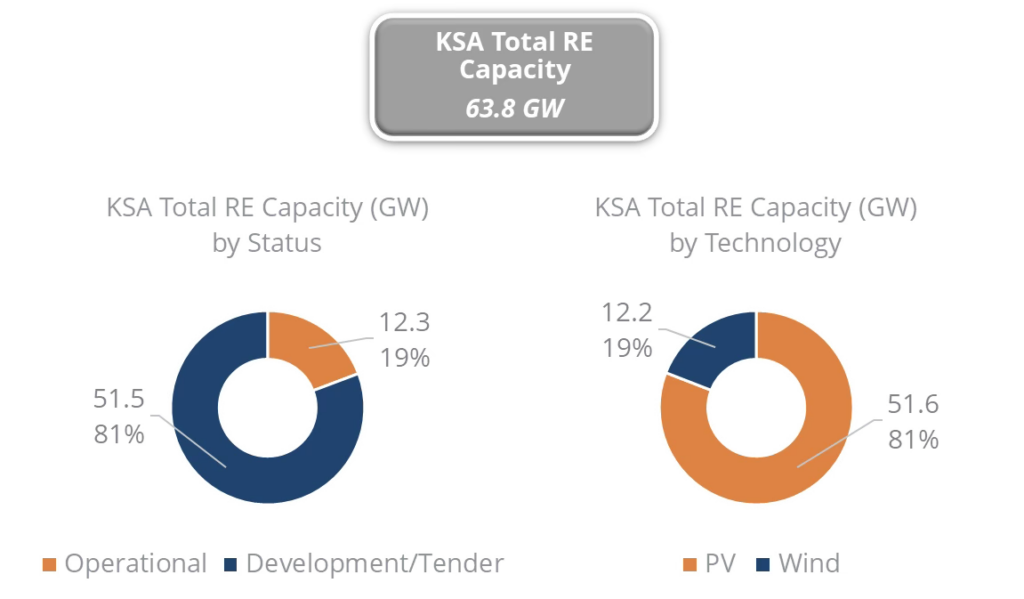
Figure 1 – KSA Total RE Market Capacity by Status and Technology, 2025-2030
With KSA’s grid witnessing a surge in renewable energy generation sources, primarily solar and wind, the requirement for flexible and reliable storage solutions to balance variable generation and maintain grid stability becomes a must have. KSA adopted and is implementing a proactive approach. As renewables become a larger share of the energy mix, the need to store excess generation, dispatch power during periods of low production and provide grid services has become critical. This fueled the rapid expansion of energy storage capacity. In here, KSA choose utility scale battery energy storage systems (BESS). Such development established KSA as the largest RE market by capacity in the MENA region (Figure 2). A quick snapshot of KSA’s utility scale battery energy storage system capacities:
- Total number of committed BESS projects and initiatives till date: 22
- Total committed BESS capacity till date: 69,915 MWh
- Total under development/tender BESS capacity till date: 58,290 MWh
- Total number of operational BESS projects in 2025: 5
- Total operational BESS capacity in 2025: 11,625 MWh
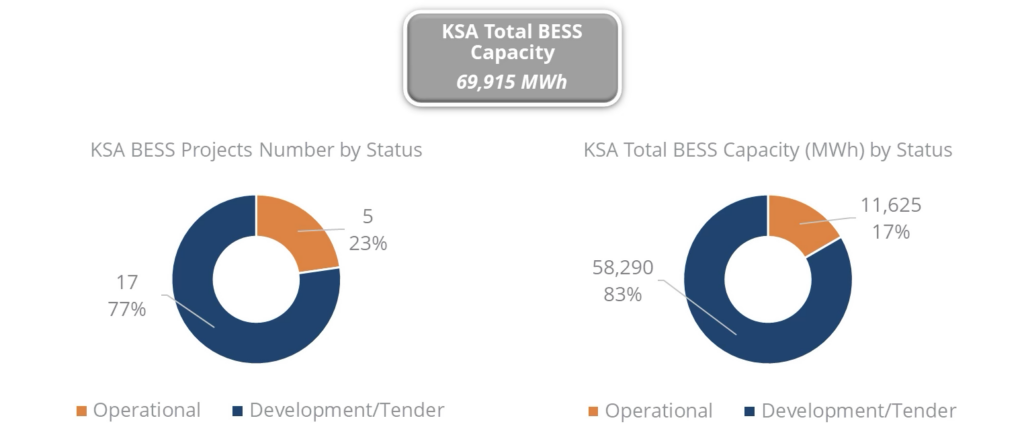
Figure 2 – KSA BESS Market Status by Number of Projects and Capacity, 2025-2030
In conclusion, KSA is making notable progress towards achieving Net Zero by 2060. The momentum is clear and evident. KSA is rapidly expanding its renewable energy sector, with significant growth in both solar PV and wind capacity projected through 2030. To support grid stability and manage variable renewable energy generation, KSA has prioritized utility scale battery energy storage systems.
References
- KSA’s updated first nationally determined contribution (NDC), UNFCCC, https://unfccc.int/sites/default/files/resource/202203111154—KSA%20NDC%202021.pdf
- Data source: Kapsarc renewables tracker, https://apps.kapsarc.org/appboard/renewableprojects
- Data source: Dii MENA and Central Asia energy storage database