
The ArcZero DC connector made from mass-balanced plastic contributes to climate-friendly production
Mathias Ohsiek, Manager Product Management Connectors for New Energies, Phoenix Contact GmbH & Co. KG, Blomberg, Germany
DC grids in industry help to improve energy efficiency, increase efficiency coefficients, and simplify installation. The advantages of a sustainable DC application are further enhanced if the connection technology used is also manufactured in the most resource-efficient way possible. An example of this is the ArcZero DC connector made from mass-balanced plastic (Figure 1).
Most electronic devices and production machines operate on direct current. Given the global use of AC grids, this statement may come as a surprise. But if you look closely, you will see that direct current is prevalent in both private and commercial environments. It seems strange then that DC technology has basically disappeared from view, most recently with the demise of DC motors in the factory. However, direct current is making a return – in the form of intelligent DC grids within an electricity-led energy transition. DC grids offer wide-ranging advantages. By using DC grids, energy losses can be reduced, grid quality improved, and renewable energies can be better integrated (Figure 2).

The ArcZero DC connector enables the efficient and safe connection of DC loads in production
Direct current in production
In industry, many loads operate on a DC link using frequency converters. For all these loads, lossy AC/DC conversion can be dispensed with in a DC grid. Renewable energies such as photovoltaics or storage systems such as fuel cells or battery storage systems can also be integrated much more efficiently into a DC grid. By intelligently controlling the power flow and networking the consumption and generation sectors, it is possible to ensure high availability and security of supply at the same time.
Due to the lack of synchronization with the 50 Hz AC power grid, it is also possible to recuperate the highly dynamic braking energy of a moving system as electrical power in the DC grid. Surpluses produced are collected in energy storage systems and fed back into the grid when necessary. Conversely, short-term peak loads can be absorbed, reducing the purchased power by up to 80%. In addition, both the peak load and the load on the distribution grid can be reduced.

Direct current in power generation: The increase in renewable energy generation, for example with photovoltaic systems, is helping the current trend toward DC gain new momentum
Setting up DC grids: Sustainability starting with installation
Another benefit of DC grids are the cost savings due to leaner installations and simplified device technology. Anyone who relies on direct current does not need five-core cables for classic AC power currents. Instead, three conductors, one for positive, one for negative, and one for protective ground, are sufficient.
On the load side, switching from AC to DC in the power supply also results in significant savings. A rectifier is not needed when devices are supplied directly with direct current. As a consequence, fewer power electronics components are needed inside the housing – paving the way for more compact solutions.
Product sustainability
In addition to application sustainability, the sustainability of the components used is also a factor that contributes to climate-friendly production. Phoenix Contact is therefore working on various ways to make its products more sustainable. Solutions are already available from Phoenix Contact in the PCB terminal blocks, connectors, and electronics housings product categories that have significantly improved carbon footprints due to process optimizations and the use of sustainable materials. A key factor here is the plastic that is used in the products.
Bio-based and mass-balanced plastics
Plastics are versatile and high-performance materials that are used in many applications. But how can plastics be made more sustainable, both in their manufacture and use? Phoenix Contact uses two approaches for its products that can contribute to increased resource efficiency and reduced environmental impact: bio-based and mass-balanced plastics.
Bio-based plastics are plastics that are made entirely or partially from renewable raw materials, such as castor oil plants, corn, or sugar cane. They can offer advantages such as reducing the dependence on fossil fuel resources, improving the environmental footprint, or increasing functionality (Figure 3).
Mass-based plastics, on the other hand, are plastics that contain a proportion of renewable or recycled raw materials that are certified using a mass balance method. This means that the alternative raw materials used are accounted for in the end products without having to be physically separated. This makes it possible to use the existing production infrastructure and reduce the carbon footprint of the products.

Significant carbon savings can be achieved in plastic-based components by using sustainable raw materials
One example of a product made from mass-balanced plastic is the ArcZero DC connector, which enables the efficient and safe connection of DC loads in a factory hall, for example. The DC connector thus combines product sustainability with application sustainability.
ArcZero DC connector
A decisive difference between direct and alternating current is the electric arc during disconnection processes under load. In AC applications, the current and voltage oscillate. This means that zero crossings with pole reversal occur 100 times per second. This is not the case in DC applications, so a possible electric arc is not automatically extinguished. Damage to contacts and housings tends to be more frequent in a DC supply system configuration, and there is potentially a greater danger to life and health. The ArcZero connector is the only connector of its kind that actively extinguishes a DC arc. It does not work passively, for example, with sacrificial contacts, but by means of an active intelligent electronic controller, which guarantees safety for users even over a high number of insertion cycles. This unique technological approach has enabled frequent and safe plugging and unplugging under load without electric arcs in DC grids (Figure 4).
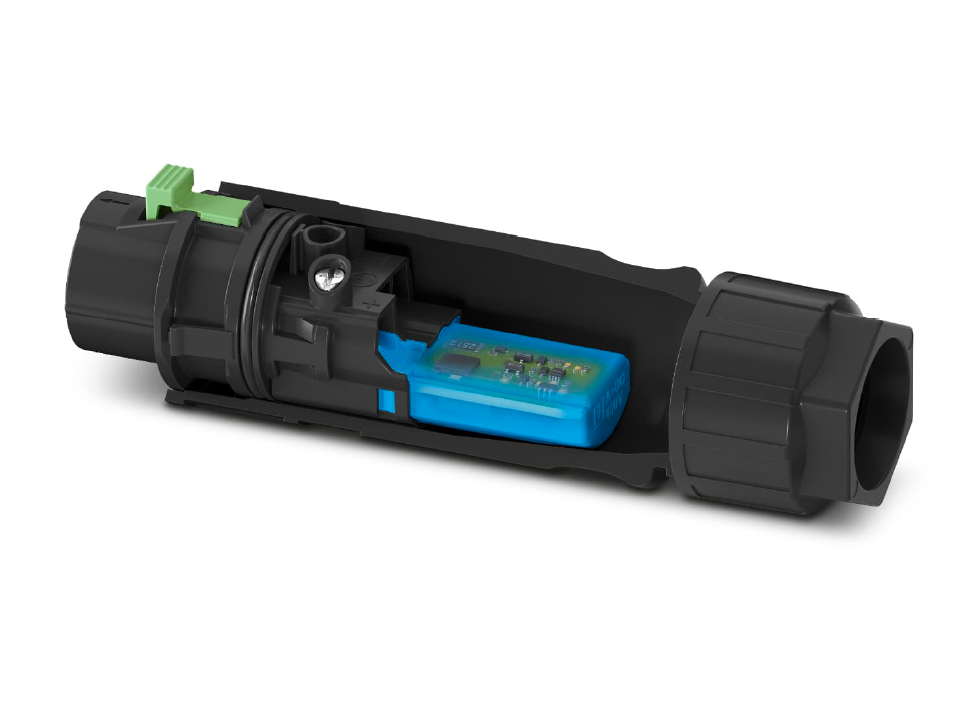
The unique technological approach of the ArcZero connector enables safe plugging and unplugging under load in DC grids
The whole unit is packaged in a housing concept that has been established and tested over many years. With degrees of protection up to IP69, high impact strength of up to IK08, and long-term outdoor suitability, the connector can show its strengths in many areas of application, whether indoors or outdoors. End and distribution circuits up to 20 A and 400 V or 800 V can be connected using the ArcZero connector.
At the same time, it can be handled intuitively and easily. No tools are needed because the user does not need to actuate any buttons or switches. Exceptional levels of cost-effectiveness and sustainability are ensured through the potentially high number of insertion cycles.
Summary
The charm of a DC power grid lies most notably in measurable efficiency improvements, rising efficiency coefficients, and simplified installation. For example, braking energy can be recovered more easily and renewable energy can be integrated more directly. The advantages of climate-friendly DC technology are enhanced if the components used have also been manufactured in the most resource-efficient way possible – as in the case of the ArcZero DC connector made from mass-balanced plastic.
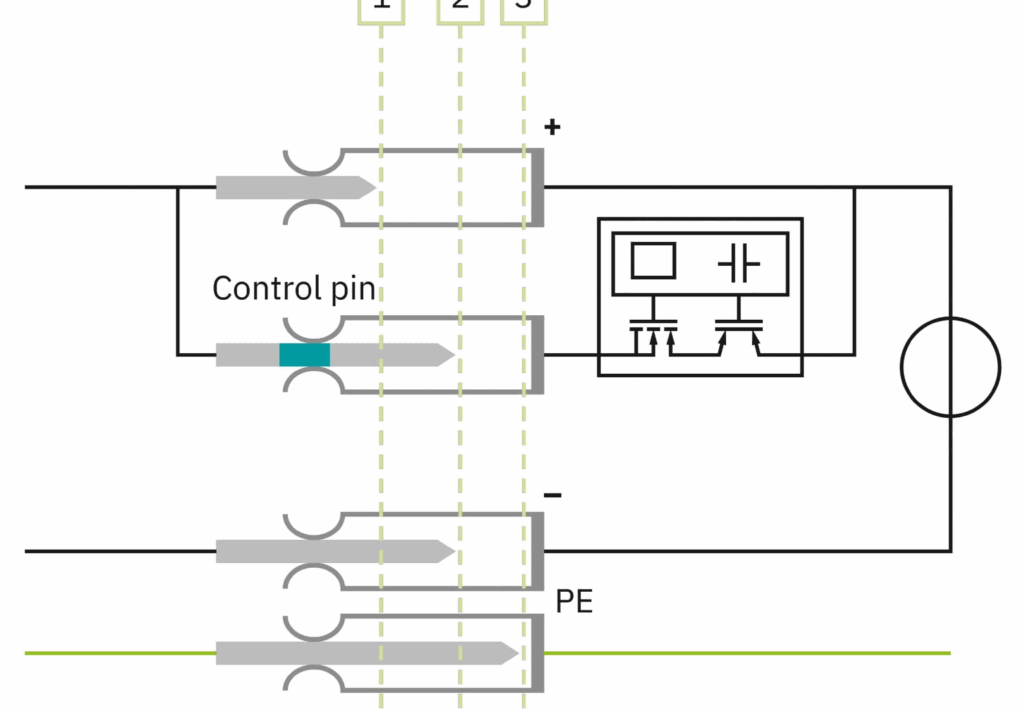
How safe isolation under load works
During normal operation, the current flows through the positive and negative contacts, the control contact is isolated in this position. If the connector is disconnected, the following steps are performed inside the connector (Figure 5).
1 The positive contact is designed to be slightly shorter than the negative contact. This means that it is disconnected first during the disconnection process.
2 At the same time, the control contact is routed from the isolated area to the conductive area. From this moment on, the current flows through the electronics, which reliably opens the circuit.
3 The circuit is open and current is no longer flowing. In the next step of the disconnection process, the control contact and negative contact disconnect without arcing. PE is designed as a leading contact so that it is disconnected last.