
By Fadi Maalouf, Chief Technology Officer, Dii Desert Energy
The ongoing conflict in the Middle East has shaken global energy markets. Oil and gas flows have been disrupted, prices have jumped, and supply routes are under threat. But instead of slowing down the global energy transition, these events show why the world must accelerate it. Clean energy is not only about climate: it is about security of supply, cost stability, sustainability, and speed-acceleration of building a safer energy system for all. These are the four dimensions of the energy transition. Figure 1 presents a snapshot visualization of key features and benefits.
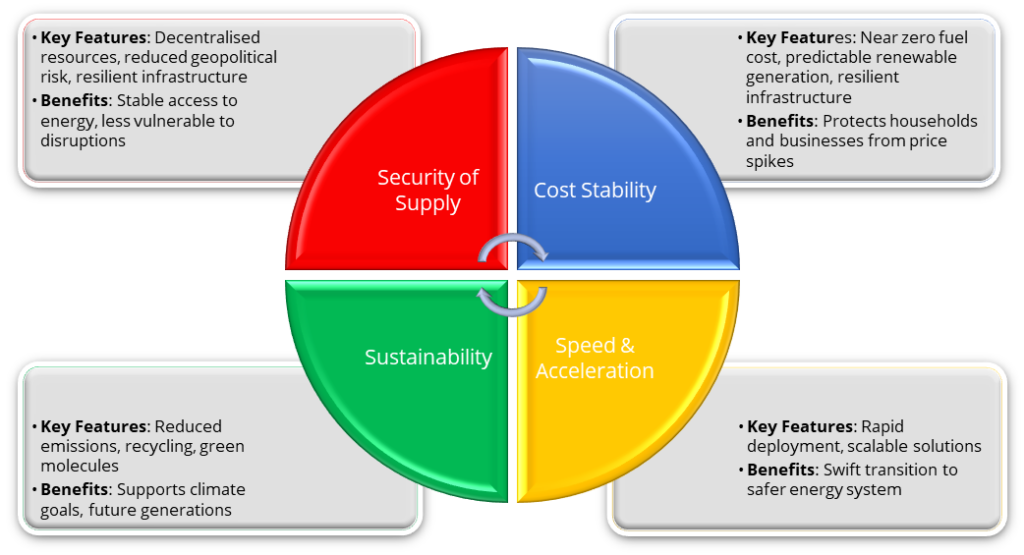
The Middle East conflict has caused the largest oil supply disruption in history, with crude flows through the Strait of Hormuz falling significantly from around 20 million barrels per day. LNG supply has also dropped by around 20% due to attacks on key facilities. Furthermore, refined products production has faced disruption due to attacks on refineries in GCC. Oil and gas prices have surged sharply with Brent crude is up ~50% since the start of hostilities. This crisis shows a simple truth that when the world depends on fossil fuels concentrated in a few regions, every conflict becomes a global energy crisis.
The clean energy pillars of solar, wind, batteries, electrification, heat pumps, efficiency, recycling and green molecules reduce energy risk because:
- Natural resources of solar and wind are not concentrated reserves like fossil fuels. Such natural resources available globally and thus are decentralized.
- Clean energy can be produced locally, not shipped through chokepoints.
- Clean energy has no fuel supply chain that can be disrupted.
- Clean energy spreads energy production across many countries, improving resilience.
- It is worth noting that as per IEA, secure clean energy supply chains and diversified critical minerals are now essential pillars of global energy security. Going forward, this risk should be elevated to critical focus.
Oil and gas price spikes hit households and businesses immediately. The poorest households in advanced economies spend nearly 25% of their income on energy. Such critical social impact should be addressed on priority basis. Clean energy helps stabilize costs because:
- Solar and wind have near zero fuel cost.
- Renewable energy generation achieves stable and predictable long term competitive energy costs. This inherently provides hedge and protection against price fluctuations.
- Battery storage and demand response help keep electricity prices stable.
- Countries with more renewables experience less volatility during crises.
Even during geopolitical crises, climate change continues to worsen and not pause. The Middle East conflict does not reduce climate risks. It might add to them by delaying action due to supply disruptions or shifting short term policy priorities. Staying on course with the energy transition:
- Cuts CO₂, methane and other pollutants emissions. Bonus: improves air quality and reduces health impacts. Carbon/Emission pricing via Emissions Trading Systems (ETS) is a good policy tool.
- Reduces climate‑related economic losses. According to a study on the macroeconomic effects of climate change by the National Bureau of Economic Research, each 1°C increase in global temperature can be linked to a 12% decline in global GDP. The urgency of climate change mitigation is undeniable.
Moreover, the World Economic Forum’s 2025 Energy Transition Index shows that clean energy investment has passed $2 trillion, and countries with higher renewable shares saw faster recovery from recent price shocks. For example, countries like Denmark, which generate a significant portion of their electricity from wind and solar, experienced less severe impacts and rebounded more quickly from energy price volatility because their reliance on domestic renewables shielded them from global fossil fuel market fluctuations.
The conflict has shown how quickly fossil fuel supply can collapse. Clean energy systems can be built faster:
- Speed matters. Every delay increases vulnerability.
- Solar and wind farms can be deployed reasonably fast.
- Battery storage is scaling rapidly. Batteries and demand‑response systems provide short‑term flexibility and help keep costs down.
- Grid upgrades and digital tools accelerate flexibility.
- Diversified geographic procurement of green molecules provide long duration energy storage that mitigate extended shocks or disruptions.
To stay on course, countries must strengthen the foundational elements and key enablers of the clean energy transition:
- Bolster transparent and predictable long‑term policies that reduce investor risk and accelerate clean energy deployment.
- In regions where carbon pricing measures are absent, implement an Emissions Trading System.
- Fortify the backbone of energy systems: modernize grids, increase energy storage (green electrons and molecules) and design flexible power systems. These are crucial to integrate renewables at scale.
- Boost investments: as per IEA, global clean‑energy investment must rise from $3.3 trillion in 2025 to $4.8 trillion per year by 2035 to meet NZE climate and security goals.
- Secure the diversification critical minerals and clean‑tech manufacturing to avoid new dependencies.
The Middle East conflict has made one thing obvious: the world cannot rely on fossil fuels only for long‑term stability. Every disruption, price spike, and supply shock reinforces the need for a cleaner, safer, more resilient energy system. Staying on course with the global energy transition is not just valid, it is urgent. The world must accelerate action across security, cost, sustainability, and speed to build an energy system that can withstand crises and support long‑term prosperity.
References
- Dii Editorial Q3 2025, Global Energy Transition: The Fourth Dimension!
- Investing.com, Brent Oil Chart, as of 23rd March 2026
- IEA World Energy Outlook 2024, Security, affordability and sustainability
- IEA, Strategies for affordable and-fair clean energy transitions
- NBER, The Macroeconomic Effects of Climate Change
- World Economic Forum, Fostering Effective Energy Transition 2025
- IEA, World energy Outlook 2025, Net Zero Emissions by 2050, Acting now to limit overshoot